Tanki Master N5
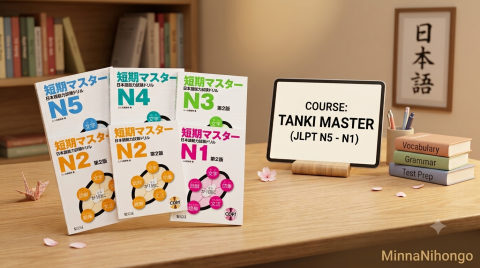
JLPT N5 short-term master drills: vocabulary, grammar, reading, and listening practice & tests from Tanki Master N5.
Who this course is for
This course is designed for self-learners and JLPT candidates preparing for N5, with emphasis on exercises, listening, reading, vocabulary through structured lessons and guided practice. Short-term intensive drills from the Tanki Master exam prep series. Ideal if you want exam-style review, daily study habits, and measurable progress without a classroom schedule.
Lessons
- Vocabulary Practice 1 — The first practice lesson on kanji and basic vocabulary from Tanki Master N5. This content helps review readings, meanings, and familiar word usage while introducing common JLPT N5 question formats. A key foundation before moving forward.
- Vocabulary Practice 2 — A writing and vocabulary practice lesson with exam-style question types that train character recognition, meaning retention, and contextual usage. Suitable for reinforcing basic N5 vocabulary knowledge.
- Vocabulary Practice 3 — Focuses on commonly confused words and meaning-distinction questions. Helps improve recognition speed, answer accuracy, and familiarity with detailed vocabulary questions in JLPT N5 tests.
- Vocabulary Practice 4 — A combined kanji and vocabulary review with slightly increased difficulty to check retention from earlier lessons. Reflects real exam formats and helps assess current ability and review weak areas.
- Vocabulary Test 1 — Comprehensive kanji and vocabulary practice for learners who completed basics. Reinforces recognition, meaning retention, and progress evaluation after N5 review.
- Vocabulary Test 2 — Follow-up vocabulary practice with varied question formats requiring contextual accuracy. Helps verify consistency and precision in vocabulary retention.
- Vocabulary Test 3 — Focuses on frequently used vocabulary and easily confused word pairs. Expands lexicon while improving response speed and accuracy.
- Vocabulary Test 4 — Comprehensive kanji and vocabulary review with broader coverage. Useful for consolidating knowledge and stabilizing foundations before other sections.
- Grammar Practice 1 — Basic grammar practice covering particles and everyday sentence patterns. Reinforces simple structures and introduces common JLPT N5 grammar question types. An important starting step.
- Grammar Practice 2 — Expands essential N5 grammar structures through continued practice. Trains learners to distinguish confusing patterns and apply them correctly in complete sentences.
- Grammar Practice 3 — Comprehensive grammar practice with higher challenge, combining multiple learned patterns. Strengthens sentence analysis skills and reinforces core grammar before moving on.
- Grammar Test 1 — Integrated grammar practice covering core N5 structures. Tests application of patterns in full sentences while reinforcing correct particle usage.
- Grammar Test 2 — Extended grammar exercises targeting confusing particles and structures. Develops context-appropriate selection and strengthens grammar mastery.
- Grammar Test 3 — Higher-level integrated grammar review combining patterns across the curriculum. Reinforces analytical skills and long-term retention.
- Reading Practice 1 — First reading comprehension lesson using short passages and simple vocabulary. Designed to introduce JLPT N5 reading format and develop main-idea identification skills.
- Reading Practice 2 — Reading practice based on everyday contexts such as notices, instructions, and short dialogues. Trains learners to locate key information and improve accuracy under time limits.
- Reading Practice 3 — More advanced reading practice requiring interpretation and inference. Builds focus, reading speed, and familiarity with common JLPT N5 question patterns.
- Reading Practice 4 — Longer reading passages with increased information density. Helps develop text processing ability and gradual improvement of foundational reading proficiency.
- Reading Practice 5 — Integrated reading exercises including emails, notes, and short informational texts. Develops selective reading and comparison skills based on realistic exam scenarios.
- Reading Practice 6 — Final reading practice simulating structured mock tests. Enables self-evaluation of comprehension, speed, and accuracy before progressing further.
- Reading Test 1 — Reading comprehension practice using short passages and direct questions. Builds habit of careful reading and information verification.
- Reading Test 2 — Reading exercises emphasizing detail search within passages. Improves selective reading and precise answer identification.
- Reading Test 3 — More difficult reading practice requiring inference beyond keywords. Develops contextual understanding and analytical thinking.
- Reading Test 4 — Integrated reading exercises with longer passages and layered information. Trains focus, organization of ideas, and handling similar answer choices.
- Listening Practice 1 — Introductory listening practice featuring simple conversations with slow delivery. Helps learners capture keywords and main ideas.
- Listening Practice 2 — Listening exercises based on everyday communication scenarios. Develops comprehension of structure and response to spoken information.
- Listening Practice 3 — More complex listening tasks with dense information and inference-based questions. Improves concentration and processing speed.
- Listening Practice 4 — Comprehensive listening practice progressing from simple to complex. Enables self-assessment and preparation for advanced listening sections.
- Listening Test 1 — Basic listening practice with clear speech and stable pacing. Trains identification of main information and familiar vocabulary.
- Listening Test 2 — Realistic listening scenarios requiring analysis of conversation flow and key points. Enhances structural and semantic recognition.
- Listening Test 3 — Longer listening content with increased detail to train memory and information organization. Suitable for improving N5 listening ability.
- Listening Test 4 — Integrated listening exercises arranged from easy to difficult. Strengthens listening foundations and focus skills at beginner level.